
Accommodate or Fail:
The Business Case for Universal Design
JUNE 2022
Across digital platforms, workplaces, and the built environment, organizations increasingly recognize the importance of user-centered design. Positive user experiences are closely linked to customer loyalty, employee retention, improved productivity, and stronger brand perception¹.
Universal design extends this principle further: environments, products, and services should be designed so they can be used by the widest range of people possible. When systems accommodate diverse users, they perform better for everyone.
The responsibility for accessibility should not rest on individuals adapting to systems that exclude them. Instead, products, environments, and interfaces must be designed to accommodate variation in ability, age, and circumstance. The broader the range of users a system supports, the stronger its performance outcomes become.
Examples across industries demonstrate the measurable value of inclusive design. In the 1990s, OXO introduced its Good Grips kitchen tools, originally designed to help people with arthritis handle utensils more comfortably. Despite costing three times more than standard peelers, the products became a commercial success and helped establish OXO as a global design brand². Online, improvements to accessibility can similarly expand reach: when Legal & General redesigned its website for accessibility, traffic increased by 25% within twenty-four hours and eventually by 50%³.
Workplace expectations also highlight the role of inclusive systems. The large-scale workforce shifts often referred to as the Great Resignation revealed how misalignment between employee needs and workplace environments can influence retention and organizational stability⁴.
Together these examples reinforce a simple conclusion: inclusive systems produce stronger business outcomes.
What is Universal Design?
Universal design refers to the practice of creating environments, products, and services that can be accessed, understood, and used by the greatest range of people possible, regardless of age, size, ability, or disability.
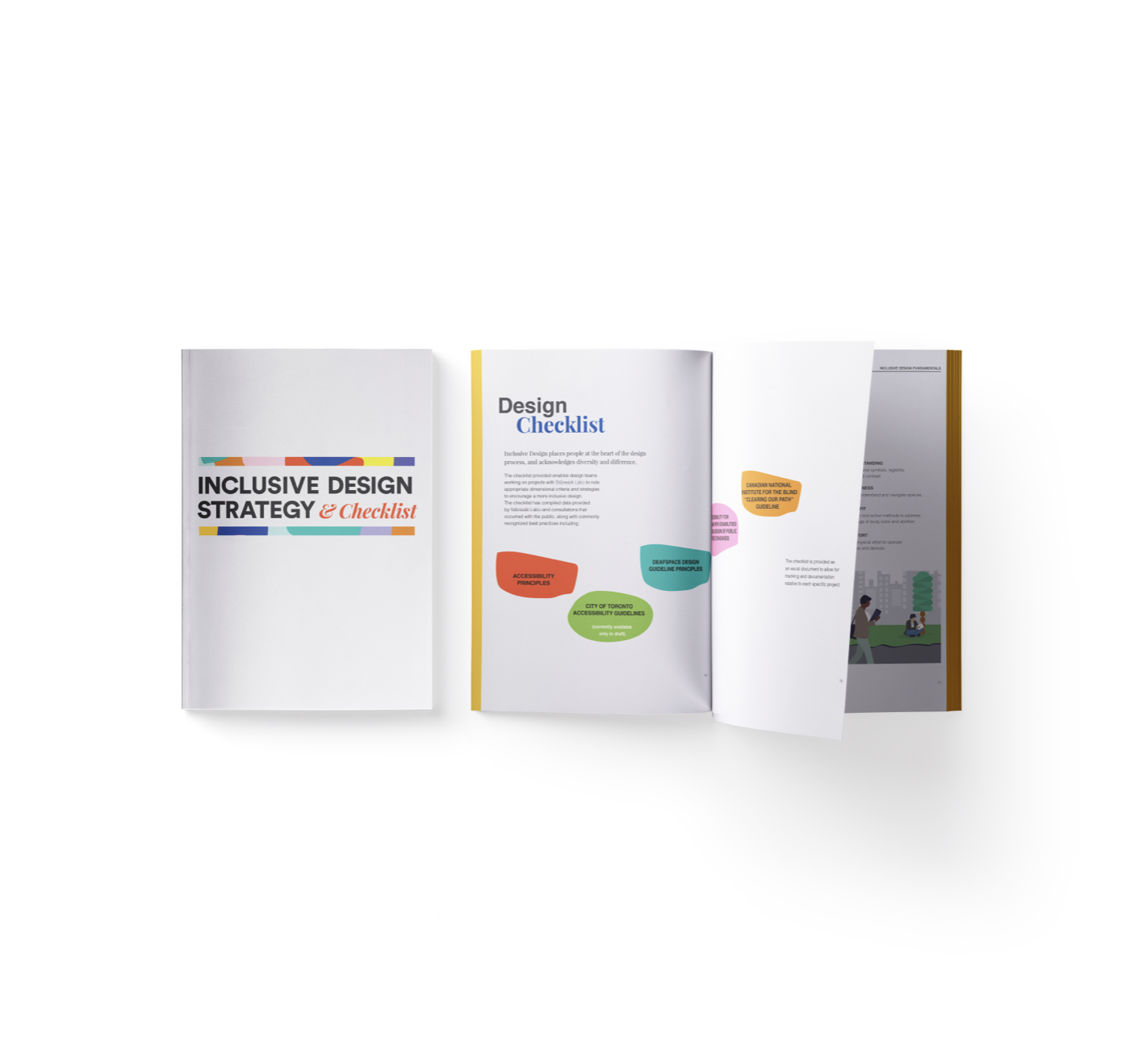
In professional practice, universal design requires integrating accessibility considerations early in the design process rather than treating them as late-stage compliance requirements. During my work with accessibility strategist Amy Pothier, our teams developed communication tools that translated building codes, accessibility standards, and workplace guidelines into visual systems that could be understood across design and technical teams.
These efforts included illustrated handbooks, checklists, and guidelines for large organizations seeking to design workplaces that support accessible use. Such frameworks demonstrate how inclusive design can be operationalized through clear communication systems and structured design standards.
Who benefits from universal design?
In short: everyone.
Universal design is often misunderstood as a specialized accommodation for a small segment of the population. In reality, it represents a foundational principle of good design. Environments that are accessible, intuitive, and comfortable to use benefit all users.
The importance of inclusive design continues to grow as global demographics shift. With approximately 15% of the global population, more than one billion people worldwide live with some form of disability⁵. Rates are increasing due to aging populations and rising prevalence of chronic health conditions.
Disabilities can also be temporary, situational, visible, or invisible. Accessibility considerations therefore extend far beyond mobility challenges to include cognitive, sensory, neurological, and health-related conditions. Designing systems that account for this diversity results in environments that are more adaptable, resilient, and humane.
A Brief History
Recognition of the need for inclusive environments has developed gradually over time. Before industrialization, communities often addressed disability through localized support networks. As urbanization expanded, standardized buildings and infrastructure were increasingly designed around an “average” user, unintentionally excluding many individuals.
Over the twentieth century, advocacy movements and legislative reforms began addressing these exclusions. Accessibility standards, civil rights legislation, and building codes established new expectations for equitable access to public spaces, transportation, and workplaces.
-
Organized activism begins after journalist Nellie Bly exposes horrid conditions faced by people with mental conditions, who were viewed as objects of pity, requiring charity rather than accommodations to live independently.
-
A group of young adult New Yorkers form an advocacy group during the Great Depression, specifically for employment for people with disabilities.
-
Disabled WWII veterans in the 1940s and 1950s, with the support of a national audience of thankful citizens, placed increasing pressure on government to provide rehabilitation and vocational training.
Between 1960 and 1963, President John F. Kennedy organized committees on the research and treatment of disability.
In 1961, The American National Standard Institute published its first standard for accessible design:
-
fter years of activists lobbying Congress, civil rights of people with disabilities were protected by law for the first time in history
-
After decades of campaigning and lobbying, the ADA was passed to ensure equal treatment and access of people with disabilities to employment opportunities and public accommodations.
-
A working group of architects, product designers, engineers and environmental design researchers, led by the late Ronald Mace in the North Carolina State University, challenge the afterthought-approach to accessibility by releasing a guide:
-
Edward Steinfeld and Jordana Maisel publish a much-needed reference to the latest thinking in universal design.
Implementing Universal Design
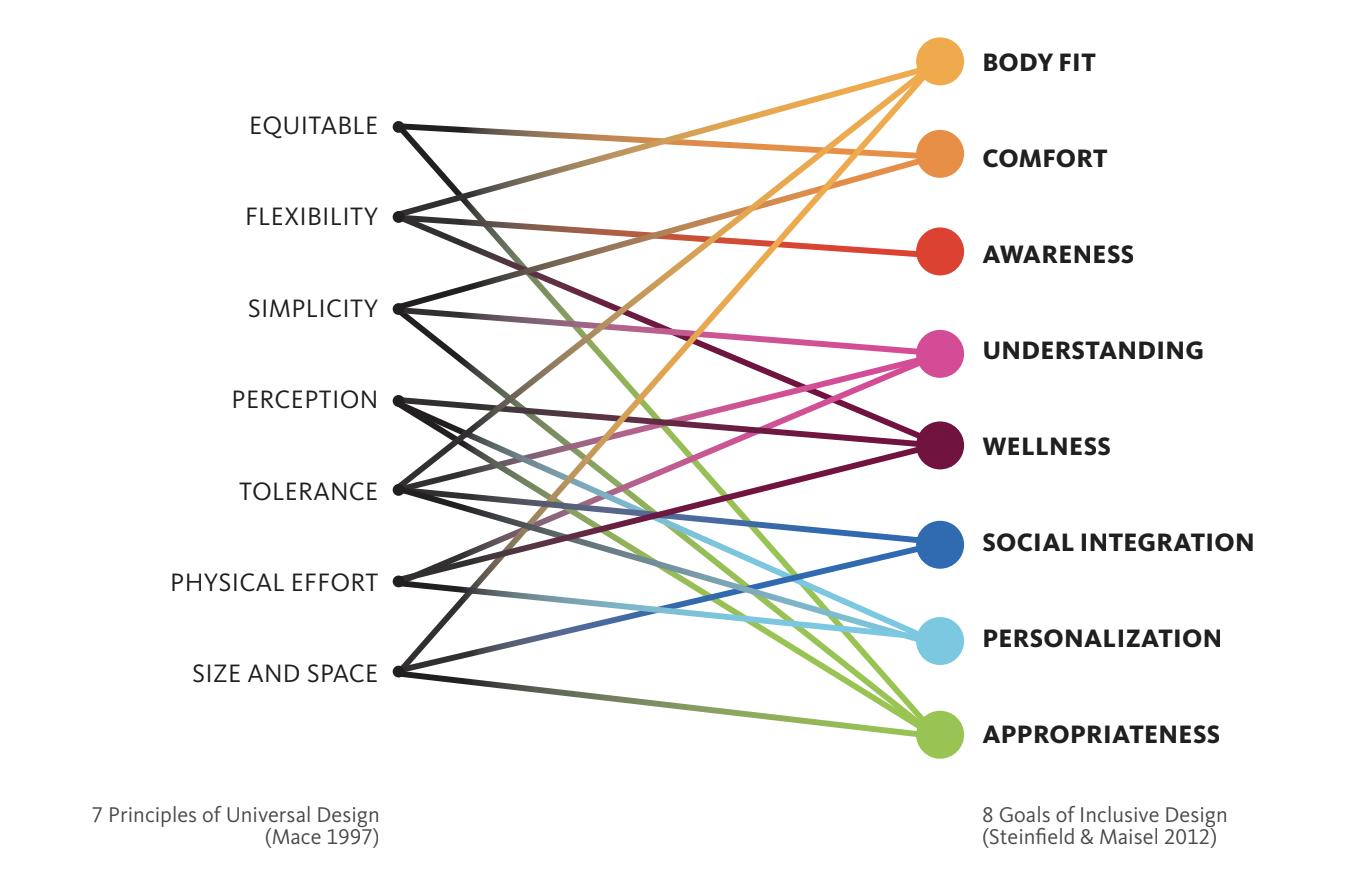
Universal design can be applied through structured frameworks that guide decision-making throughout the design process. One widely referenced framework is Steinfeld and Maisel’s Eight Goals of Universal Design, which address principles such as body fit, comfort, awareness, understanding, wellness, social integration, personalization, and cultural appropriateness⁶.
These principles encourage designers to consider not only compliance requirements but also the broader human experience of interacting with environments and systems.
-
Passive and active methods to address the range of body sizes and abilities
-
Low physical effort to operate spaces and devices helps all.
-
Safely understand and navigate spaces.
-
International symbols, legibility, colour and contrast.
-
A universal concept that promotes a healthy and safe environment.
-
Consider everyone in designing social spaces.
-
User control and choice for personal and group spaces.
-
Consider cultural values and context in all experiences.
Using Visual Systems to Communicate Universal Design
Communicating accessibility standards across complex projects requires clear visual frameworks. Policies, building codes, and technical guidelines can be difficult for interdisciplinary teams to interpret without structured communication tools.
In many of the projects I contributed to, designers worked closely with accessibility consultants, brand teams, and technical specialists to translate regulatory requirements into visual guidance systems. These systems included flat design illustrations, axonometric diagrams, floor plans, icon libraries, and branded visual assets that could communicate design intent consistently across large organizations.
By converting policy into visual language, design teams help ensure that accessibility principles are not only documented, but understood and implemented in practice.


Selected research and references:
¹ WTW (Willis Towers Watson). 2021 Employee Experience Survey: Insights on Employee Engagement and Workplace Experience. 2021.
² New York Times. Samuel Farber, Developer of OXO Kitchen Utensils, Dies at 88. 2013.
³ W3C / DRC. The Business Case for Digital Accessibility. 2005.
⁴ McKinsey & Company. The Great Attrition Is Making Hiring Harder. Are You Searching the Right Talent Pools? 2021.
⁵ World Health Organization. Disability and Health. 2021.
⁶ Steinfeld, Edward & Maisel, Jordana. Universal Design: Creating Inclusive Environments. Wiley, 2012.